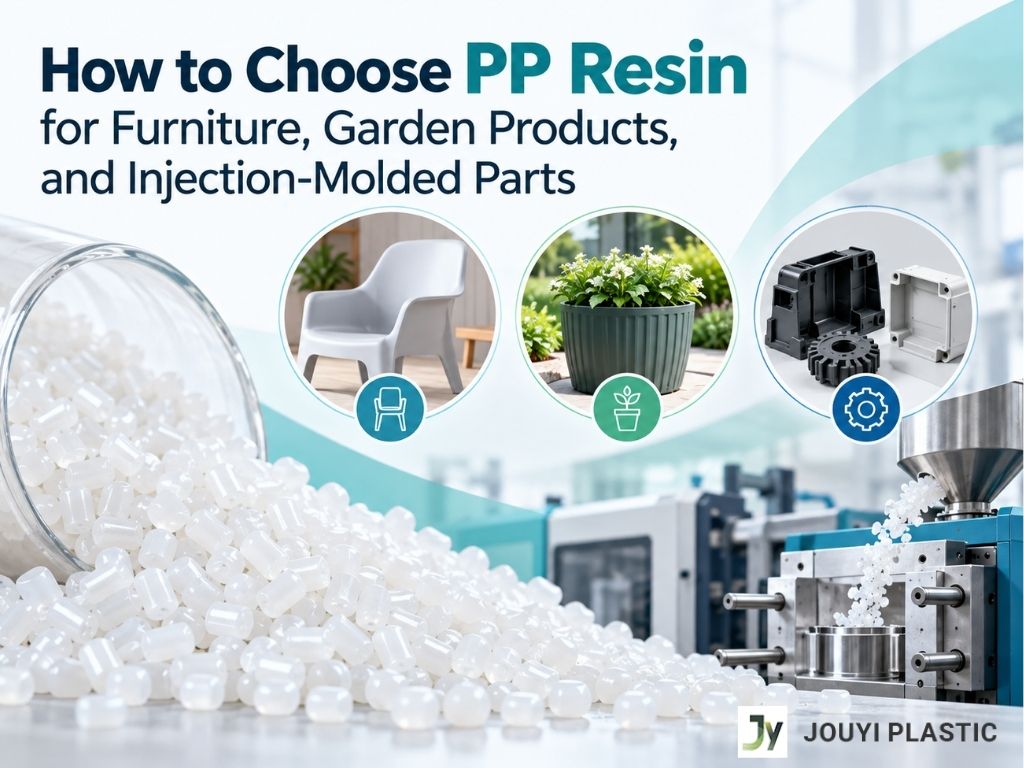
Polypropylene (PP) is widely used in furniture, garden products, household goods, appliance components, and other injection-molded parts because it combines low density, toughness, processability, chemical resistance, and cost efficiency.
However, choosing the right PP resin involves more than selecting a material labeled simply as “PP.” Different products may require different levels of impact resistance, melt flow, stiffness, weather resistance, dimensional stability, color consistency, or recycled content.
For manufacturers, the right material therefore depends on both the end-use environment and the molding process.
This guide explains how to evaluate PP resin for furniture, garden products, and injection-molded components, including the properties that should be discussed with a PP material supplier before production.
What Is PP Resin?
PP resin, or polypropylene resin, is a thermoplastic material commonly processed into pellets or granules for injection molding and other plastic manufacturing processes.
It is widely selected because it offers a useful balance of low weight, toughness, chemical resistance, moisture resistance, and manufacturing efficiency.
Depending on the formulation, PP pellets can be modified to achieve different levels of:
- Impact resistance
- Stiffness
- Melt flow
- Heat resistance
- UV resistance
- Dimensional stability
- Color consistency
- Surface appearance
This is why two materials both described as PP resin may behave very differently during molding and in the finished product.
For manufacturers, material selection should therefore start with the required product performance rather than simply comparing PP pellet prices.
Why Is PP Widely Used for Injection-Molded Products?
PP is well suited to injection molding because it can provide good flowability, relatively low density, useful toughness, and flexible formulation options.
These characteristics allow manufacturers to use PP in products ranging from large furniture parts to smaller household and industrial components.
Typical applications include:
- Chairs and furniture components
- Storage products
- Planters and garden accessories
- Household products
- Appliance components
- Containers and housings
- Industrial plastic parts
PP can also be modified when standard grades cannot provide the required mechanical, processing, appearance, or outdoor-performance properties.
As a result, “Which PP should we use?” should normally be followed by a second question:
What must the finished component do?
Which PP Properties Matter Most?
The most important PP resin properties depend on the product design, molding equipment, and end-use conditions.
| Property | Why It Matters | Typical Application Concern |
|---|---|---|
| Melt flow | Affects mold filling and processing behavior | Large or complex injection-molded parts |
| Impact resistance | Helps components withstand drops, loads, or sudden impacts | Furniture, household products |
| Stiffness | Helps components retain their shape under load | Structural furniture components |
| Weather resistance | Helps maintain performance during outdoor exposure | Garden and outdoor products |
| UV resistance | Helps reduce degradation caused by sunlight | Outdoor furniture and planters |
| Dimensional stability | Helps control deformation and part consistency | Assemblies and precision components |
| Heat resistance | Important when products experience elevated temperatures | Appliances and industrial parts |
| Color consistency | Helps maintain visual consistency between production batches | Consumer-facing products |
| Surface appearance | Influences visual and tactile quality | Furniture and household goods |
Not every application needs maximum performance in every category.
A garden planter, for example, may prioritize weather resistance and color stability, while a chair component may require greater toughness and structural stability.
How to Choose PP Resin for Furniture
PP resin for furniture should be selected according to load requirements, impact resistance, appearance, dimensional stability, and whether the product will be used indoors or outdoors.
Furniture components frequently experience repeated loading, movement, impact, and long service periods. Large molded parts can also be sensitive to shrinkage or deformation.
Structural Stability
Chair shells, supports, storage furniture, and other load-bearing parts need sufficient mechanical stability to maintain their shape during use.
The exact formulation should therefore reflect the expected load and component geometry.
Impact Resistance
Furniture is frequently moved, stacked, dropped, or subjected to repeated impacts.
For these applications, toughness can be more important than maximizing stiffness alone.
Surface and Color Requirements
Visible furniture components often need consistent color and appearance across multiple production batches.
Material formulation and color compounding should therefore be controlled together rather than treated as completely separate purchasing decisions.
Indoor vs. Outdoor Use
PP raw material for furniture intended for outdoor use may require greater weather and UV resistance than material used only in indoor environments.
A supplier should know the intended environment before recommending a formulation.
How to Choose PP Resin for Garden Products
PP resin for garden products should prioritize weather resistance, UV stability, impact performance, processability, and resistance to moisture and normal outdoor exposure.
Garden products may spend long periods outside under sunlight, temperature changes, humidity, and rain.
Typical PP garden applications can include:
- Planters
- Gardening accessories
- Storage products
- Outdoor household products
- Garden equipment components
Weather Resistance Matters
Outdoor exposure can gradually affect the appearance and mechanical properties of plastics.
For this reason, a formulation intended for outdoor applications should be evaluated differently from a standard indoor PP grade.
UV Stability Is Especially Important
Sunlight is one of the major environmental factors affecting outdoor plastics.
Where prolonged outdoor use is expected, suitable UV-resistant formulations or additives may be required to help maintain material performance.
Flowability Can Affect Large Garden Products
Large planters, containers, and complex molded shapes may require PP with suitable flow characteristics so the resin can fill the mold efficiently.
This means the “best” PP resin for garden products must balance both product durability and molding performance.
How to Choose Injection Molding Grade PP
Injection molding grade PP should match the mold geometry, wall thickness, part size, machine conditions, and required mechanical performance of the finished product.
There is no single melt-flow level or PP grade that is ideal for every injection-molded component.
- Thin-wall parts may need easier material flow.
- Large molded parts may require good mold-filling performance.
- Structural components may prioritize mechanical properties.
- Outdoor components may require UV and weather resistance.
- Decorative components may require tighter color consistency.
Manufacturers should therefore provide their material supplier with relevant processing and product information instead of requesting only “injection molding grade PP.”
This makes material recommendations more precise and reduces the risk of trial-and-error during production.
Why Does Melt Flow Matter in PP Injection Molding?
Melt flow influences how easily molten PP travels through the mold and fills the required geometry during injection molding.
If the material does not flow appropriately for the part design and processing conditions, manufacturers may encounter filling difficulties or inconsistent production.
However, higher melt flow is not automatically better.
Material selection requires a balance between:
- Flowability
- Mechanical strength
- Impact performance
- Part geometry
- Processing conditions
A high-flow formulation may be useful for certain large, thin, or complex components, but the final selection should still be evaluated against the performance requirements of the finished product.
This is why melt flow should be treated as one part of the overall material specification rather than the only selection criterion.
When Is High-Impact PP Needed?
High-impact PP is useful when a molded component must tolerate repeated loading, drops, vibration, movement, or sudden mechanical force.
Applications that may benefit from higher impact resistance include:
- Chairs
- Furniture components
- Storage products
- Tool-related plastic parts
- Garden equipment
- Household products
However, increasing impact performance may affect other properties.
For example, a formulation optimized for toughness may not provide exactly the same stiffness or processing characteristics as another PP grade.
The correct approach is therefore to define a realistic performance balance instead of maximizing one property independently.
How Do Weather and UV Exposure Affect PP Selection?
Outdoor PP products usually require additional consideration for UV exposure, weathering, temperature variation, and long-term color stability.
Standard material that performs well indoors may not necessarily provide the same long-term performance outdoors.
Manufacturers producing outdoor furniture or garden products should discuss:
- Expected outdoor exposure
- Geographic climate
- Product service life
- Color requirements
- Temperature range
- Mechanical load
- Surface appearance
These factors can determine whether a standard PP formulation is suitable or whether a customized weather-resistant formulation is more appropriate.
How Do Color Requirements Affect PP Compounding?
Color should be considered part of the material-development process when consistent appearance is important to the finished product.
Consumer products such as furniture, planters, household goods, and appliance components often require repeatable colors across multiple production batches.
Black PP granules are common in many applications, but black is not automatically a single standardized material specification.
Different formulations can vary in:
- Blackness
- Surface appearance
- Filler content
- Recycled content
- Mechanical properties
- Processing behavior
For products requiring a specific appearance, manufacturers should define both the color target and the required material performance.
Custom color matching and PP compounding can then help align visual requirements with functional properties.
Virgin PP vs. Recycled PP: What Should Manufacturers Consider?
The choice between virgin and recycled PP should be based on required performance, consistency, sustainability objectives, processing needs, and end-use specifications.
Recycled PP can provide manufacturers with a way to incorporate circular materials into suitable products, but recycled material selection should still follow technical criteria.
Material Consistency
Recycled material intended for manufacturing needs controlled specifications so production remains stable from batch to batch.
Mechanical Performance
Required strength, toughness, stiffness, and other properties should be defined according to the actual component.
Color Stability
Visible products may require tighter control over color and appearance.
Processing Stability
Consistent melt-flow behavior is important for reliable molding operations.
End-Use Requirements
Not every PP formulation is suitable for every product.
A recycled PP material should therefore be selected and formulated according to its intended application rather than selected solely based on recycled content.
When Is Customized PP Compounding a Better Choice?
Customized PP compounding is useful when standard PP pellets cannot simultaneously meet the product's mechanical, processing, weathering, and appearance requirements.
A manufacturer may need customized material when a component requires a specific combination of:
- Toughness
- Stiffness
- Melt flow
- UV resistance
- Heat resistance
- Dimensional stability
- Color
- Recycled content
Compounding allows these requirements to be considered as part of one material-development process.
For example, an outdoor furniture manufacturer may require recycled PP with controlled color, higher toughness, weather resistance, and suitable mold-filling characteristics.
Rather than selecting these properties independently, a customized formulation can be developed around the actual application and manufacturing conditions.
Standard PP or Reinforced PP: Which Should You Use?
Standard PP is suitable for many furniture, household, and garden products, while reinforced polypropylene may be more appropriate when higher stiffness, heat resistance, strength, or dimensional stability is required.
Glass fiber or mineral reinforcement can modify the mechanical performance of PP.
Typical options include:
- Standard polypropylene
- Glass fiber reinforced polypropylene
- Mineral-filled polypropylene
However, reinforced PP should not automatically be considered an upgrade for every product.
The correct choice depends on whether the component actually requires the additional mechanical or dimensional properties.
For general household products, furniture, and garden applications, a properly formulated standard PP may already provide the required balance of cost, toughness, processability, and durability.
A Practical PP Resin Selection Checklist
Before selecting PP pellets or requesting a customized PP compound, manufacturers should prepare the following information:
- What is the finished product?
Explain whether the material will be used in furniture, garden products, appliances, household goods, or industrial components. - Is the product used indoors or outdoors?
Outdoor use may introduce UV and weather-resistance requirements. - What mechanical properties matter most?
Identify whether the component needs toughness, stiffness, impact resistance, dimensional stability, or another specific property. - What is the molding process?
Provide relevant information about injection molding conditions, part size, wall thickness, and mold complexity. - Are there specific melt-flow requirements?
Processing needs should be matched to the component design and equipment. - Is recycled content required?
Define sustainability or recycled-material objectives early in the material-selection process. - Does the product require a specific color?
Color requirements should be considered alongside formulation and production consistency. - Are additional properties required?
Examples may include UV resistance, heat resistance, low odor, or improved dimensional stability.
Providing these details allows the material supplier to evaluate the application as a complete system rather than simply recommending a generic PP grade.
Choosing the Right PP Is About Matching Material to Application
Selecting PP resin is not simply a choice between different PP pellets or granules.
Furniture manufacturers may prioritize toughness, structural stability, color, and appearance. Garden product manufacturers may require weather resistance, UV stability, and suitable flowability. Injection molders may focus on processability, mold filling, dimensional consistency, and repeatable production.
The best PP material is therefore the one that achieves the required balance of product performance, processing stability, appearance, cost, and sustainability.
At JOUYI PLASTIC INDUSTRY CO., LTD., we specialize in recycled plastic pelletizing, material development, formulation adjustment, quality inspection, color matching, and customized recycled material solutions. Our PP materials are developed for applications including furniture, household and garden products, appliances, and industrial components.
By understanding the finished product and production requirements first, we can help manufacturers develop a PP material solution that better matches both processing conditions and application performance.
Looking for PP resin, recycled PP pellets, or a customized PP formulation for your next product?
Contact JOUYI PLASTIC to discuss your application requirements.
Frequently Asked Questions
What PP resin is commonly used for furniture?
PP used for furniture should provide an appropriate balance of toughness, stiffness, dimensional stability, processability, and appearance. Outdoor furniture may also require enhanced UV and weather resistance. The correct formulation depends on the component design and expected use conditions.
What PP resin is suitable for garden products?
PP resin for garden products should generally be evaluated for weather resistance, UV stability, impact performance, flowability, and color stability. Large or complex injection-molded garden products may also require material with suitable mold-filling characteristics.
What is injection molding grade PP?
Injection molding grade PP refers to polypropylene formulated with processing characteristics suitable for injection molding. The correct grade depends on mold design, component size, wall thickness, required melt flow, and finished-part performance.
Are PP pellets and PP granules the same?
The terms PP pellets and PP granules are often used to describe small pieces of polypropylene raw material supplied for plastic processing. However, the material specification, formulation, additives, recycled content, and physical properties may differ significantly between products.
Can recycled PP be used for furniture and garden products?
Yes, recycled PP can be suitable for many furniture, household, and garden applications when the material formulation and quality are matched to the product's performance and processing requirements. Properties such as toughness, color consistency, flowability, and weather resistance should be evaluated for the specific application.
When should manufacturers consider custom PP compounding?
Custom PP compounding should be considered when standard material cannot provide the required combination of mechanical properties, processing behavior, UV resistance, heat resistance, color, dimensional stability, or recycled content. A customized formulation can be developed around the actual product and manufacturing requirements.