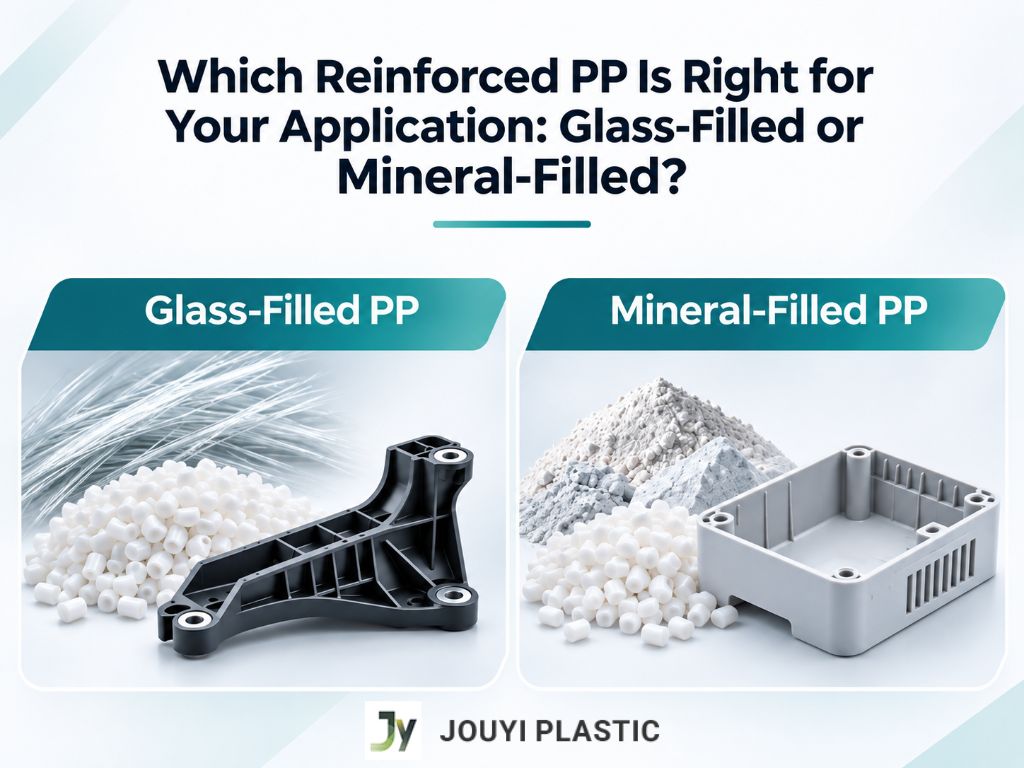
Standard polypropylene (PP) offers low density, good toughness, chemical resistance, and efficient processing, but some applications require greater stiffness, strength, heat resistance, or dimensional stability.
This is where reinforced PP compounds become important.
Two common options are glass-filled polypropylene (PPGF) and mineral-filled polypropylene (PPMF). Both improve the performance of standard PP, but they are designed for different priorities.
The right choice depends on the finished component, molding conditions, mechanical requirements, appearance, and service environment.
Quick Answer: Which Reinforced PP Is Right for Your Application: Glass-Filled or Mineral-Filled?
Glass-filled polypropylene is generally preferred when higher stiffness, mechanical strength, heat resistance, and structural performance are required. Mineral-filled polypropylene is often a better fit when dimensional stability, balanced mechanical properties, surface requirements, low water absorption, and cost efficiency are the main priorities.
Neither material is automatically better. The correct reinforced PP compound should be selected according to the actual performance and processing requirements of the finished component.
What Is Glass-Filled Polypropylene?
Glass-filled polypropylene is a PP compound reinforced with glass fiber to increase stiffness, mechanical strength, heat resistance, and dimensional stability.
Glass fiber changes the mechanical behavior of polypropylene compared with unfilled PP.
Typical benefits include:
- Higher stiffness
- Increased mechanical strength
- Improved heat resistance
- Better dimensional stability
- Greater structural performance
Because of these properties, PPGF is commonly considered for components that must support loads or maintain their shape under demanding operating conditions.
Typical applications include:
- Automotive interior components
- Appliance housings
- Industrial components
- Structural plastic parts
- Mechanical assemblies
At JOUYI PLASTIC, PPGF is part of the modified polypropylene product range developed for applications requiring higher performance than standard PP.
What Is Mineral-Filled Polypropylene?
Mineral-filled polypropylene is PP compounded with mineral reinforcement to improve dimensional stability, mechanical properties, heat resistance, and overall cost-performance balance.
Compared with standard PP, mineral reinforcement can help reduce deformation and improve molded-part consistency.
Typical advantages include:
- Improved dimensional stability
- Increased mechanical strength
- Enhanced heat resistance
- Low water absorption
- Competitive material cost
- Balanced industrial performance
Mineral-filled PP is particularly useful when a component needs more stability than standard PP but does not require the same level of structural reinforcement provided by glass fiber.
What Is the Difference Between PPGF and PPMF?
The main difference between PPGF and PPMF is the reinforcement material and the resulting balance of strength, stiffness, dimensional stability, appearance, processing, and cost.
Glass fiber generally provides stronger structural reinforcement, while mineral reinforcement is often selected for dimensional control and balanced performance.
| Property | Glass-Filled PP (PPGF) | Mineral-Filled PP (PPMF) |
|---|---|---|
| Reinforcement | Glass fiber | Mineral reinforcement |
| Stiffness | High | Improved over standard PP |
| Mechanical strength | High | Moderate to improved |
| Dimensional stability | Very good | Very good |
| Heat resistance | Improved | Improved |
| Surface appearance | May be influenced by fiber | Often suitable for appearance-sensitive parts |
| Water absorption | Low | Low |
| Structural performance | Strong advantage | Suitable for moderate structural needs |
| Typical applications | Automotive, appliances, industrial parts | Industrial parts, housings, dimensional-stability applications |
The best choice should not be based on one property alone.
A component may require high stiffness but also need acceptable surface appearance, stable shrinkage, moldability, and controlled material cost.
Which Material Provides Higher Strength and Stiffness?
Glass-filled polypropylene is usually the better choice when high stiffness and structural strength are the primary requirements.
Glass fibers reinforce the PP matrix and help the material resist deformation under mechanical load.
This makes PPGF suitable for applications such as:
- Structural brackets
- Automotive components
- Appliance supports
- Industrial housings
- Load-bearing plastic parts
However, maximum stiffness is not always necessary.
A highly reinforced material may also introduce different processing behavior, surface characteristics, density, or mold-design considerations.
For components that require only moderate reinforcement, PPMF may provide a more balanced solution.
Which Material Provides Better Dimensional Stability?
Both PPGF and PPMF can improve dimensional stability compared with standard polypropylene, but the best choice depends on part geometry, reinforcement level, and molding conditions.
Dimensional stability is important when molded parts must maintain:
- Consistent shape
- Assembly tolerances
- Flatness
- Controlled deformation
- Repeatable dimensions
Glass fiber provides strong reinforcement and can help reduce deformation in structural components.
Mineral reinforcement can also improve dimensional control and may be particularly useful in molded parts where stable shrinkage and consistent geometry are important.
The final material should therefore be evaluated together with the mold design and processing conditions.
Which Material Is Better for Heat Resistance?
Both glass-filled and mineral-filled PP can provide better heat-related performance than standard polypropylene, but PPGF is often selected when mechanical strength must also be maintained under elevated temperatures.
PPMF can also provide improved thermal stability and dimensional control for suitable industrial applications.
For heat-exposed components, manufacturers should evaluate:
- Operating temperature
- Duration of heat exposure
- Mechanical load at temperature
- Part dimensions
- Required dimensional stability
- Product lifecycle
Heat resistance should not be evaluated independently from structural requirements.
Which Reinforced PP Is Better for Automotive Components?
Glass-filled PP is often preferred for automotive components that require higher stiffness, strength, heat resistance, and dimensional stability.
Potential applications include:
- Interior structural components
- Supports
- Brackets
- Housings
- Under-dashboard parts
- Other molded automotive components
JOUYI PLASTIC identifies automotive interior components as one of the key applications for PPGF.
However, not every automotive component requires glass fiber reinforcement.
For parts where dimensional stability, appearance, cost, and moderate reinforcement are more important than maximum structural strength, mineral-filled PP may also be considered.
The material should therefore be selected according to the actual component requirements rather than the automotive application category alone.
Which Reinforced PP Is Better for Appliance Housings?
Both PPGF and PPMF can be used for appliance-related components, but the right material depends on rigidity, heat exposure, dimensional control, appearance, and structural requirements.
PPGF may be appropriate when the part requires:
- Higher rigidity
- Better mechanical strength
- Improved heat resistance
- Greater structural stability
PPMF may be more suitable when the priorities include:
- Dimensional stability
- Consistent molding
- Balanced mechanical performance
- Competitive cost
- Surface requirements
For visible appliance housings, surface appearance should be considered early in the material-selection process.
How Does Reinforcement Affect Injection Molding?
Reinforcement changes the flow, shrinkage, mechanical behavior, and processing characteristics of polypropylene, so reinforced PP should not be treated exactly like standard PP during molding.
Flowability
Adding reinforcement can change how molten PP flows through the mold.
Part thickness, flow length, gate design, and injection conditions should therefore be considered when selecting a reinforced grade.
Shrinkage
Reinforced PP generally behaves differently from standard PP during cooling.
This can affect:
- Mold dimensions
- Part tolerances
- Warpage
- Assembly fit
Fiber Orientation
For glass-filled PP, fiber orientation can influence both mechanical performance and dimensional behavior.
The direction of material flow may therefore affect the final properties of the molded part.
Surface Quality
The type and amount of reinforcement can also influence surface appearance.
For highly visible components, appearance requirements should be considered before the material and tooling are finalized.
What Reinforcement Level Should You Choose?
The correct reinforcement level depends on the required balance of stiffness, strength, flowability, appearance, dimensional stability, and processing performance.
A higher reinforcement percentage does not automatically mean better overall performance.
Increasing reinforcement may affect:
- Flowability
- Surface quality
- Processing conditions
- Density
- Mold wear
- Impact behavior
- Material cost
For example, manufacturers should not specify PP GF30 simply because 30% glass fiber is commonly available.
Does the component actually require the mechanical performance provided by that reinforcement level?
The reinforcement percentage should be selected based on the finished product rather than on a standard market specification alone.
When Should You Use Standard PP Instead?
Standard PP may be the better choice when the product does not require additional stiffness, structural strength, heat resistance, or dimensional stability.
Reinforcement should solve a real design or performance problem.
Standard PP may already be suitable for:
- Household goods
- Garden products
- Non-structural furniture parts
- Containers
- General injection-molded products
Using reinforced PP unnecessarily can increase material complexity and cost without providing meaningful value.
The most efficient material is not always the strongest material.
How Do You Choose the Right Reinforced PP Compound?
Start with the performance requirements of the finished component, then choose the reinforcement system that best matches those needs.
The following table provides a practical starting point:
| Requirement | Recommended Starting Point |
|---|---|
| High stiffness and structural strength | PPGF |
| Improved dimensional stability | PPGF or PPMF |
| Moderate reinforcement with cost balance | PPMF |
| Automotive structural component | PPGF |
| Appliance support requiring rigidity | PPGF |
| Appearance-sensitive molded housing | Evaluate PPMF |
| Heat resistance plus structural strength | PPGF |
| General dimensional control | PPMF |
| Non-structural general molded part | Standard PP |
This table should be used as a preliminary guide rather than as a final material specification.
Mechanical Load
Will the part carry weight, resist bending, or experience repeated stress?
Higher structural requirements generally favor PPGF.
Dimensional Requirements
Does the component require tight tolerances, good flatness, or stable assembly dimensions?
Both PPGF and PPMF may be suitable depending on the design.
Heat Exposure
Will the component experience elevated operating temperatures?
Consider both the temperature and the mechanical load applied at that temperature.
Surface Appearance
Is the component visible to the end user?
The type and level of reinforcement can influence the final surface.
Injection-Molding Conditions
Review:
- Wall thickness
- Mold complexity
- Flow length
- Gate design
- Machine capability
- Expected cycle stability
Weight and Cost
The strongest compound is not automatically the most economical solution.
A mineral-filled or lower-reinforcement material may already meet the required performance.
Additional Requirements
The application may also require:
- UV resistance
- Low odor
- Specific color
- Recycled content
- Customized strength
- Thin-wall molding performance
These requirements should be considered together during material development.
Should You Choose Glass-Filled PP or Mineral-Filled PP?
Choose glass-filled PP when structural strength and rigidity are the main priorities. Choose mineral-filled PP when dimensional stability and balanced material performance are more important.
For applications requiring higher stiffness, mechanical strength, heat resistance, and structural performance, PPGF is often the stronger starting point.
For applications requiring dimensional stability, low water absorption, balanced mechanical properties, and competitive cost, PPMF may be more appropriate.
The final decision should be based on:
- Mechanical requirements
- Heat exposure
- Dimensional tolerances
- Surface appearance
- Injection-molding conditions
- Weight targets
- Cost targets
- End-use environment
At JOUYI PLASTIC INDUSTRY CO., LTD., we develop modified PP compounds including PPGF glass fiber reinforced polypropylene and PPMF mineral reinforced polypropylene for automotive, appliance, and industrial applications.
Our material development capabilities include UV resistance, dimensional stability, thin-wall injection molding, low-odor formulations, and customized strength and color solutions.
Looking for the Right Reinforced PP Compound?
If you are comparing PPGF, PPMF, PP GF30, or another reinforced polypropylene formulation, JOUYI PLASTIC can help evaluate the required strength, dimensional stability, processing behavior, color, and application conditions.
Contact JOUYI PLASTIC to discuss your component requirements and develop a reinforced PP compound that matches both your molding process and finished-product performance.
Frequently Asked Questions
What is PP GF30?
PP GF30 generally refers to polypropylene containing approximately 30% glass fiber reinforcement. It is commonly considered for applications requiring greater stiffness, strength, heat resistance, and dimensional stability than standard PP. However, the correct reinforcement level should be selected according to the actual component requirements.
Is PPGF suitable for automotive components?
Yes. Glass fiber reinforced polypropylene is commonly used for automotive components that require improved stiffness, strength, heat resistance, and dimensional stability. The appropriate compound depends on the specific part, molding conditions, and operating environment.
Can reinforced PP be customized?
Yes. Reinforced PP compounds can be formulated according to requirements such as reinforcement level, mechanical strength, dimensional stability, UV resistance, color, odor, processing performance, and other application-specific needs.